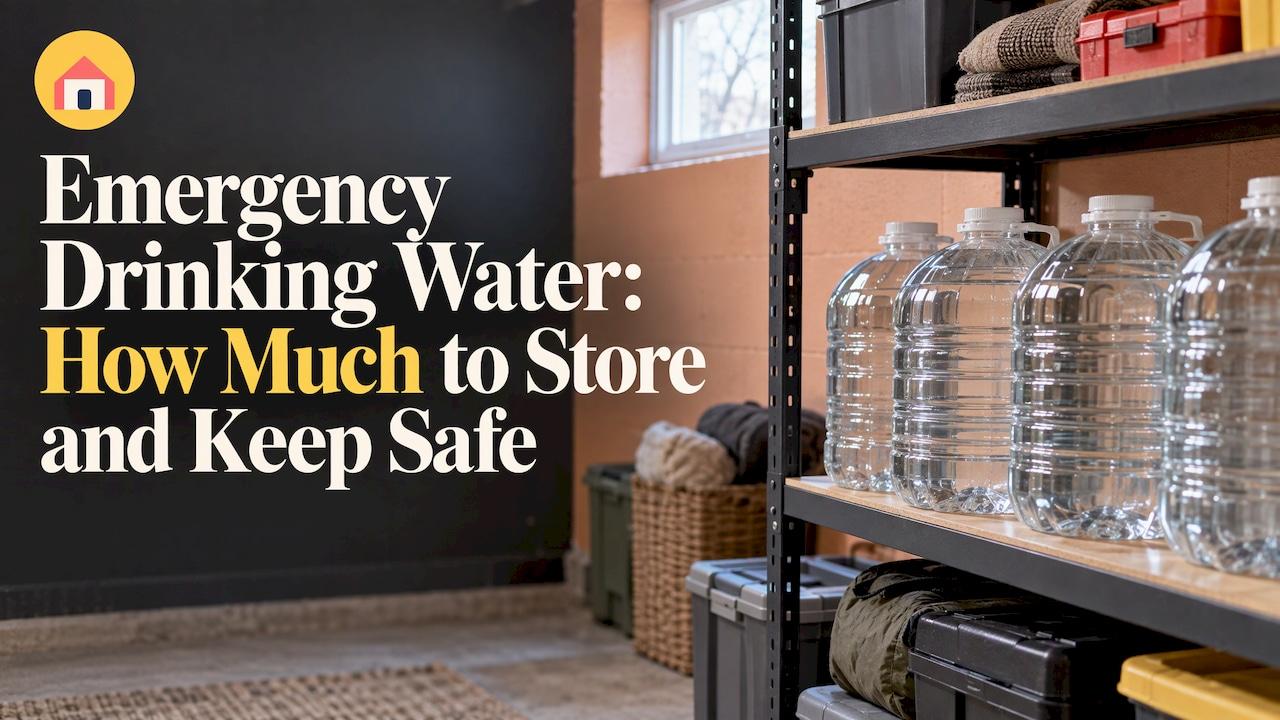
Plan on at least 2 litres of drinking water per person per day for a minimum of 72 hours, then add more for cooking, cleaning, kids, pets and medical needs. That is the national baseline, and several provinces ask for more. The right number for your home depends on who lives there, so we built our free 72-hour kit and family plan to start from your household, not a generic list.
TL;DR
- Health Canada says to keep 2 litres per person per day for at least 72 hours, plus about 2 more litres per person per day for cooking and cleaning.
- Alberta and Québec ask for more: Alberta suggests 4 litres per person per day, and Québec suggests 6 L for drinking plus 6 L for food and hygiene.
- Use clean, food-grade containers with tight lids, label them with dates and refresh them every 6 months.
- During a boil water advisory, bring water to a rolling boil for at least one minute, or disinfect with unscented bleach if boiling is not practical.
- Well owners should not use the taps during a power outage and should test the water after a flood.
Table of Contents
- How much emergency water does your household need?
- How to store emergency water safely
- Can you drink tap water during an outage?
- Making water safe at home
- Water for babies, seniors and special needs
- Where our kit fits
- A simple setup you can finish this weekend
- After the water comes back
- FAQ
- Sources
How much emergency water does your household need?
Start with the official minimum. Health Canada's guidance is to be ready for at least 72 hours, with 2 litres of water per person per day in the kit, and to consider another 2 litres per person per day for cooking and cleaning. Public Safety Canada also tells households to be self-sufficient for at least 72 hours without power or tap water.
Provinces set the bar higher:
| Source | Drinking | Other uses | Duration |
|---|---|---|---|
| Health Canada | 2 L per person per day | Consider 2 L more | At least 72 hours |
| Alberta | 4 L per person per day (more for pregnancy, illness, pets) | Included | At least 72 hours |
| Québec | 6 L per person | 6 L per person for food prep and hygiene | At least 3 days |
Sources: the Health Canada, Alberta and Québec pages. Québec's figures are for the whole period, not per day.
A worked example
Take a family of four with a dog, planning for three days. At 2 L for drinking and 2 L for cooking and cleaning, that is 4 L x 4 people x 3 days = 48 L, before the dog. If you follow Alberta's 4 L per person per day, it is 48 L as well, so 48 L is a sensible floor for this home. Add pet water on top. Québec's 6 L plus 6 L per person for three days would mean 48 L for the four of you too, which shows how close the provincial figures land when you count cooking and hygiene.

If you want more than three days, scale it up. Many households in areas with frequent outages choose a longer supply. The Plus Kit includes household quantities for up to 14 days, so the arithmetic is done for your family.
Who needs more
Alberta says to store extra for pregnant women, people with illnesses and pets. Babies who drink formula, anyone on medication that calls for extra fluids, and anyone who needs water for a medical device should have a margin above the baseline. Count that water separately so it is not eaten up by everyday use.
How to store emergency water safely
Alberta's guidance on storing water gives a clear routine:
- Choose the container. Use food-grade or durable, unbreakable containers with tight lids. Québec adds that containers should be clean and must never have held chemical products.
- Sanitize it. Mix 4 cups of water with 1 teaspoon of 5% to 9% bleach, shake, wait 30 seconds, drain and let it air dry.
- Fill and label. Write "drinking water" and the fill date on each container, plus the date to refresh it.
- Store it right. Keep it between 10°C and 20°C, away from sunlight and chemicals.
- Refresh every 6 months. Swap in fresh water on a schedule. The U.S. CDC gives the same 6-month interval for home-filled water.
Where it goes wrong: containers left in a hot garage, jugs with no date, and one big supply stored in a single place. Spread it between a cool basement shelf and a closet so one leak does not cost you everything. Put a refresh reminder in your phone calendar the day you fill the jugs.
Can you drink tap water during an outage?
Not always. The Windsor-Essex County Health Unit notes that during a power outage municipal water may no longer be safe without treatment. Health Canada says to listen to local authorities on whether tap water is safe, and if it is not, to follow their instructions and use bottled water.
Québec adds that even clear, odourless water can pose a health risk. Causes include burst or frozen mains, drought, flooding, chemical products, parasites and blue-green algae.
What a boil water advisory covers
When an advisory is issued, do not drink the tap water. Health Canada says to boil all water used for drinking, preparing food, dental hygiene, making ice, washing fruits and vegetables, and hot and cold drinks. Do not use untreated water for baby formula, washing dishes, brushing teeth or washing hands.
A few practical points from local health units:
- The Chatham-Kent Public Health Unit says to keep boiling until officials announce the advisory is over, and advises against automatic shut-off kettles because they may not boil long enough.
- The same unit says to throw out ice made before the advisory, wash trays with boiled water and make new ice from boiled, cooled water.
- The Parry Sound FAQ says tap water may be used for laundry and bathing (excluding small children). It also suggests boiling only as much water as you can comfortably lift, and using the back burner if children are home.
- Young children, immunocompromised people and anyone with open wounds should take sponge baths with boiled water, according to the Windsor-Essex unit.
Private well owners
If you are on a well, Health Canada's well guidance says not to open faucets, shower or flush toilets during a power outage, because depressurizing the system raises contamination risk. If the system loses all pressure or no water comes out, test before use. After power returns, flush the lines for a few minutes and check that any treatment system is running properly.
After floods or wildfires, a 2026 evidence review from the National Collaborating Centre for Environmental Health advises against using well water for drinking, food, ice, formula, brushing teeth, dishes or pets until it is confirmed safe, and recommends testing for total coliforms and E. coli. It also notes that boiling handles microbes but not chemical hazards. Free post-disaster testing is often available, yet few households use it.
Making water safe at home
Boiling
Boiling is the first choice. Health Canada defines a rolling boil as a vigorous boil where bubbles at the centre do not disappear when stirred, and recommends one minute at a rolling boil, or two minutes above 2,000 m, according to a 2025 peer-reviewed comparison of agency guidance. Let it cool covered, then store it in a clean sealed container. Québec says boiled water keeps in the fridge for up to 3 days or at room temperature for 24 hours.
Bleach when you cannot boil
If boiling is not practical, Health Canada says to add about 2 drops (0.2 mL) of unscented 5.25% household bleach to 1 litre of water using a clean medicine dropper, stir, and let it sit for 30 minutes. Fraser Health says to use 4 drops per litre if the water is cloudy or cold. Simcoe Muskoka Health gives six drops of newly bought unscented 4% to 6% bleach per gallon (4.55 L), and says that for formula, treated water should stand overnight, covered, in a cooler or fridge so the bleach dissipates. Purification tablets used to label directions are another option.
Use only plain, unscented bleach, and keep a small bottle and a dropper in the kit.

Filters
Fraser Health notes that most household jug-style filters do not remove microbial contaminants, so they are not a stand-in for boiling or disinfection.
Water for babies, seniors and special needs
Infants, older adults and immunocompromised people are most affected by waterborne pathogens. Fraser Health says severely immunocompromised people should always boil tap water or use commercially bottled water for drinking and cooking. The Renfrew County and District Health Unit says that if well nitrate levels exceed the Ontario standard and there is an infant under 6 months or a pregnant woman at home, use another trusted source for drinking and food preparation, formula included.
For your kit, this means labelling a separate stash for formula and medication, and noting any dietary or medical needs in your plan, not in your head.
Where our kit fits
Most families know they should store water and never work out how much. Our free 72-hour kit and family plan gives you a printable checklist for your household. The Plus Kit adds personalization for allergies and medical needs, household quantities for up to 14 days, rationing and budget worksheets, fridge posters and wallet cards, and a Junior Ready Ranger Handbook so children can help fill, label and rotate the jugs. The Plus Kit is a one-time purchase.

Start with the free 72-hour emergency kit and family plan and put your water numbers on the page before the next storm.
A simple setup you can finish this weekend
- Count people and pets, then multiply by your daily litres and number of days.
- Buy or collect clean food-grade containers.
- Sanitize, fill, label and date them.
- Store them cool and dark in two spots.
- Add unscented bleach, a dropper and a pot you can lift.
- Set a six-month reminder.
After the water comes back
Alberta's steps after a shortage: turn on all hot and cold taps to release trapped air, reopen the main valve, and run cold taps for at least 5 minutes until the water is clear and cold. If it is still discoloured after a couple of hours, test at the bathtub or shower and call your water supplier if it stays cloudy. Keep following any advisory until officials say it is lifted.
FAQ
How much drinking water per person per day for an emergency?
Health Canada says at least 2 litres per person per day for drinking, with about 2 more for cooking and cleaning. Alberta recommends 4 litres per person per day for at least 72 hours. Add more for pregnancy, illness and pets.
Can I drink tap water during a power outage?
Only if local authorities say it is safe. Municipal water may need treatment during an outage, and well systems should not be used while depressurized. Follow your local notice and use stored or boiled water if in doubt.
How long does stored water stay good?
Alberta advises refreshing home-stored water every 6 months, kept at 10°C to 20°C away from light and chemicals. Label each container with the fill and refresh dates.
How do I make water safe without boiling?
Health Canada says to add about 2 drops (0.2 mL) of unscented 5.25% household bleach per litre, stir and wait 30 minutes. Use 4 drops per litre if the water is cloudy or cold, per Fraser Health.
Sources
- Food and drinking water safety in an emergency, Canada.ca
- Emergency kits, Canada.ca
- Water shortages, Alberta.ca
- Drinking water contamination or shortage, Québec
- How to Create an Emergency Water Supply, CDC
- Safe Drinking Water During a Power Outage, Windsor-Essex County Health Unit
- Water Advisories, Chatham-Kent Public Health Unit
- Boil water advisory FAQ, Parry Sound
- Well safety during and after emergencies, Health Canada
- Private wells in a changing climate, NCCEH
- Variance among Public Health Agencies' Boil Water Guidance
- Q & A: Tap water during a boil water notice, Fraser Health
- Safe Drinking Water During A Power Failure, Simcoe Muskoka Health
- Safe Water, Renfrew County and District Health Unit